
Your personal assistant for pregnancy and the first year

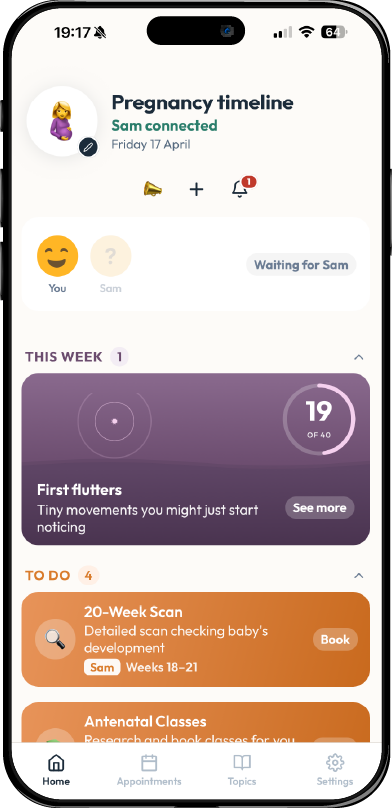
Pregnancy, birth and the first year come with more admin than anyone warns you about. ParentPA covers it all: every NHS appointment, registration, benefit and deadline, timed to your dates. Invite your partner or keep it yours.
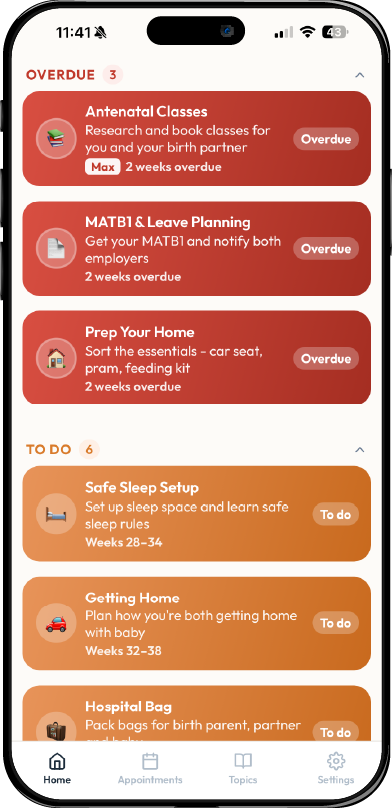
Set your due date or your baby's birthday and your timeline fills with everything that matters. Colour-coded by urgency: overdue, to do, coming up, worth doing. Booking appointments, MATB1 windows, 20-week scans, hospital prep: each card surfaces at the right moment, not a week too late.
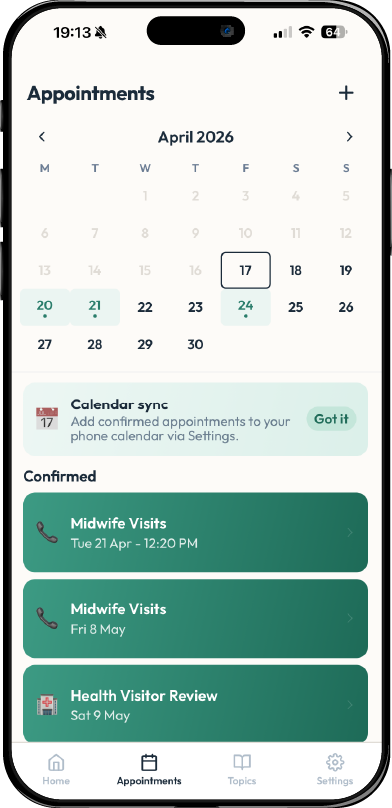
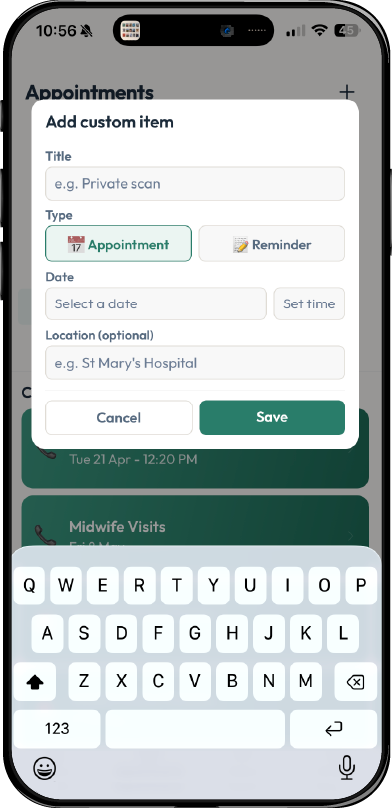
Confirmed appointments appear in one shared calendar. Add your own too: classes, private scans or anything else with a date. Reminders the evening before and morning of, straight to your phone.
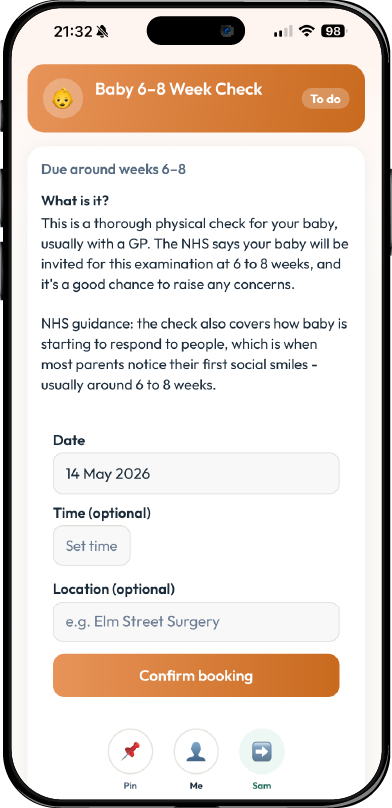
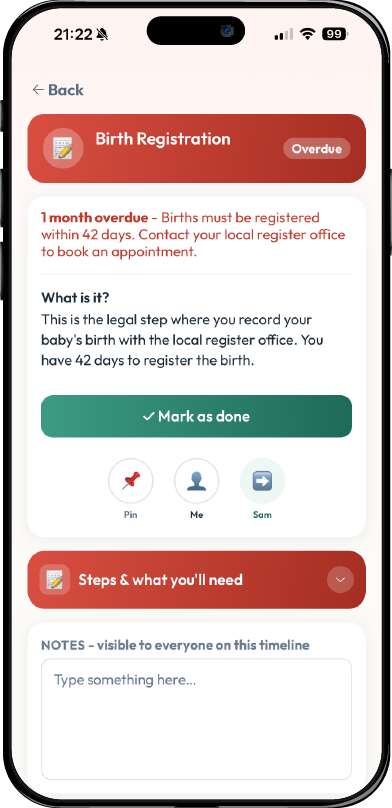
Birth registration, postnatal checks, vaccinations, childcare deadlines: the admin keeps coming. Open any card to see what to do, why it matters and the NHS or GOV.UK source behind it. It adjusts for England, Scotland, Wales and Northern Ireland.
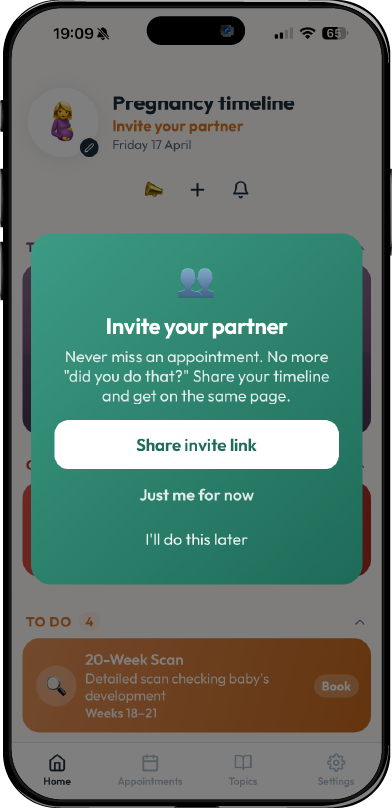
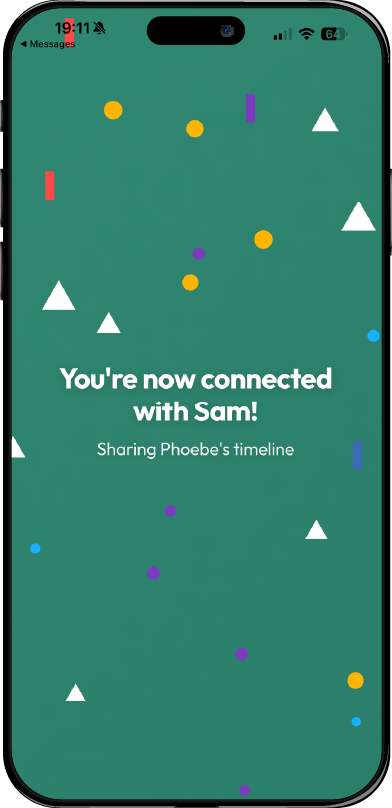
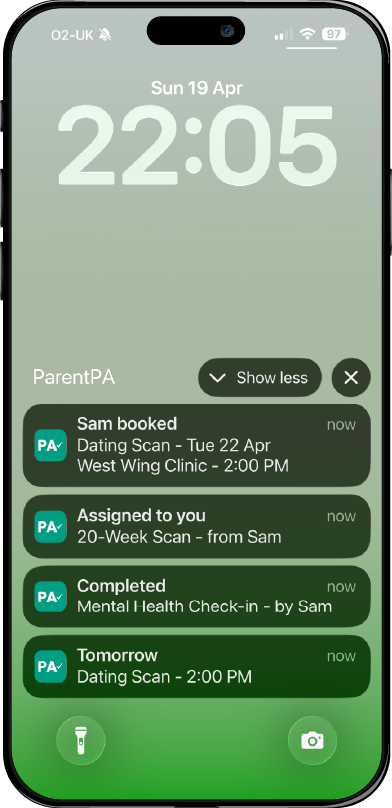
Send a link. From that moment you share one timeline: the same cards, the same appointments, the same notes. Activity feed and push notifications keep you both in the loop.
Assign cards to yourself or a partner. You both see who's handling what, what's been done and what's still outstanding. No chasing, no guessing, no things falling through the cracks.
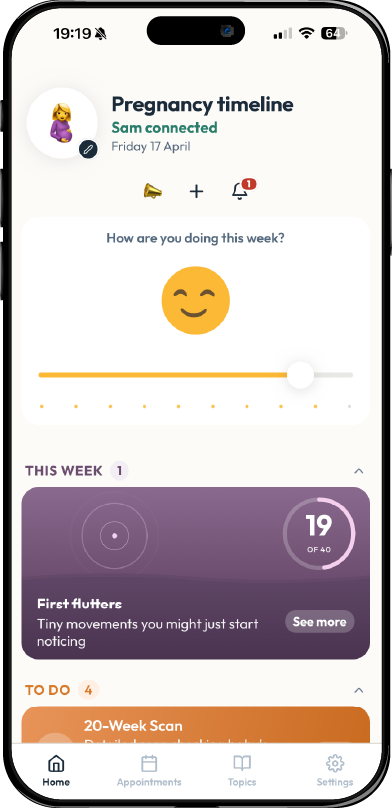
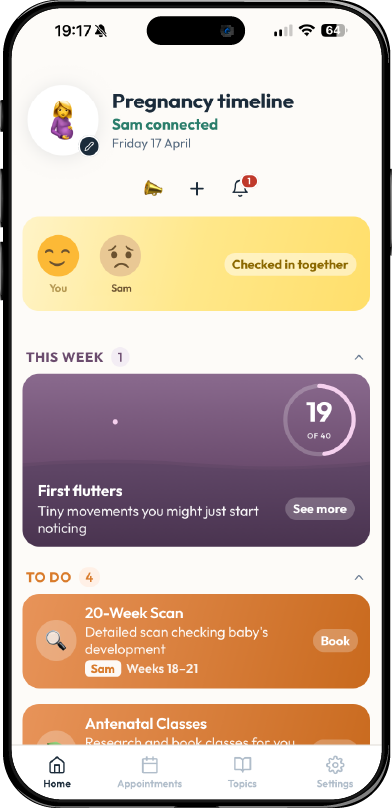
Pregnancy is physical, the first year is relentless. Each week you both tap a slider to say how you're actually feeling. No scores, no pep talks, no advice. Just a quiet weekly read on where your partner is that you wouldn't otherwise get, and a reason to ask about the weeks that slip into the red.
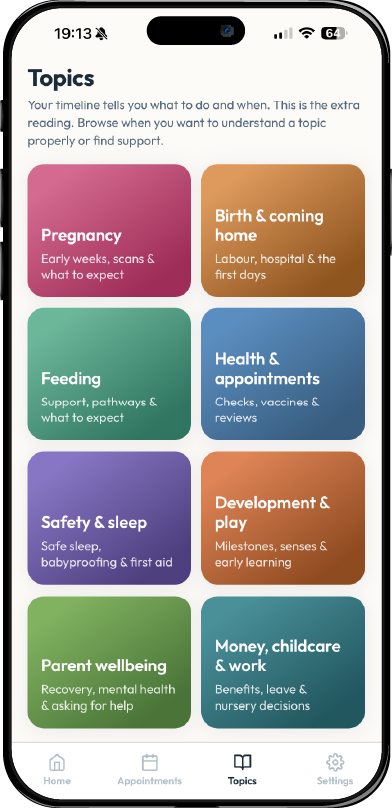
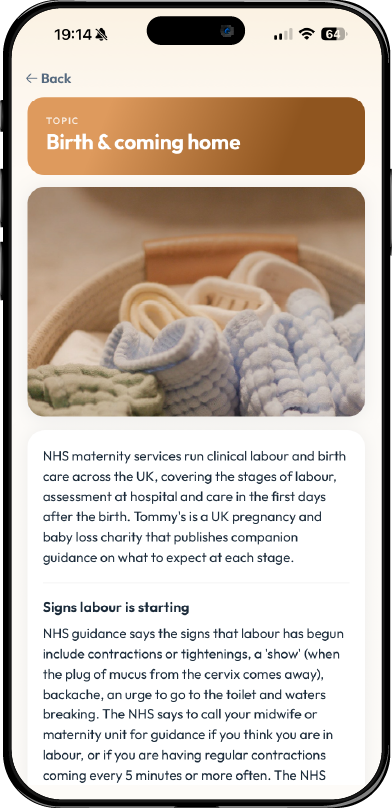
Every card pulls from the NHS, GOV.UK and other UK-specific sources. No affiliate content, no wellness blogs, no US parenting apps. Nation-specific rules adjust for England, Scotland, Wales and Northern Ireland.
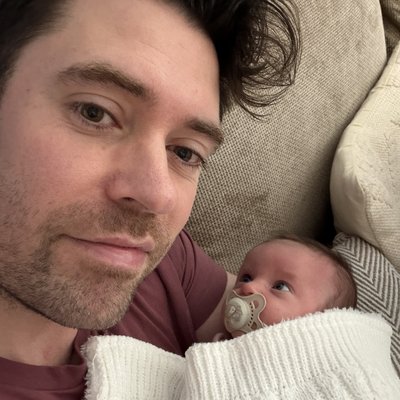
Every answer exists somewhere. Just not in the same place, not at the right time, and definitely not for both parents. When we found out we were expecting, we went looking for the app that had it all. Upcoming NHS appointments, must-do's after birth, who's doing what. It just didn't exist. So I built it.
ParentPA started with a baby in my lap during paternity leave. It covers pregnancy through the first year: scans, registrations, vaccinations, deadlines and the stuff nobody tells you about. All timed to your dates, all in one place.
In England, you'll typically have around 10 antenatal appointments for a first pregnancy, starting with a booking appointment at 8–10 weeks, a 12-week dating scan and a 20-week anomaly scan. The schedule varies slightly across Scotland, Wales and Northern Ireland. ParentPA tracks every appointment automatically once you set your due date.
Key milestones include registering with a midwife, attending your booking appointment, completing your MATB1 form, applying for the Healthy Start scheme if eligible and preparing for birth. After birth, you'll need to register your baby, apply for Child Benefit and attend postnatal checks. ParentPA surfaces each of these at the right time, timed to your due date.
Pack essentials for you (maternity notes, birth plan, snacks, comfortable clothing and toiletries) and for your baby: a sleepsuit, nappies, muslin squares and a car seat for the journey home. Most parents pack their bag from around 36 weeks. ParentPA includes a hospital bag card that surfaces at exactly the right point in your pregnancy timeline.
You can claim Child Benefit as soon as your baby is born. Payments are only backdated by 3 months, so it's worth doing straight away. Claims are made online through HMRC. ParentPA reminds you to apply in the days after birth so nothing slips through the cracks.
The NHS vaccination schedule starts at 8 weeks, with further doses at 12 weeks, 16 weeks and 1 year. Your health visitor will advise on booking these at your local GP surgery. ParentPA tracks the full vaccination timeline alongside the rest of your baby admin.
In England, Wales and Northern Ireland, you have 42 days to register your baby's birth. In Scotland the deadline is 21 days. ParentPA adjusts this deadline automatically based on your nation, so you always see the correct window, not a generic one that might not apply to you.
Your midwife or GP will issue your MATB1 form from around 20 weeks of pregnancy, no earlier than 20 weeks before your due date. You'll need it to claim Statutory Maternity Pay (SMP) or Maternity Allowance from your employer or Jobcentre Plus.
The Healthy Start scheme provides prepaid cards for food, milk and vitamins to pregnant women and families with children under 4 who receive certain qualifying benefits. You can check eligibility and apply at healthystart.nhs.uk. ParentPA flags this early in your pregnancy timeline so you don't miss out.
Your health visitor will usually make contact within 10–14 days of birth for a new birth visit, followed by a check at 6–8 weeks. They also carry out development reviews at 9–12 months and again at 2–2.5 years. Timing varies slightly by area.
Ask your midwife or GP for an FW8 form, which entitles you to free NHS prescriptions and dental treatment during pregnancy and for 12 months after your baby is born. Apply as early as possible. It isn't backdated to before your application was approved.
Eligible partners in the UK can take up to 2 weeks of Statutory Paternity Pay. Recent changes have made paternity leave more flexible. It can now be split into two blocks and taken any time in the first 52 weeks after birth. Eligibility rules have also been updated. Check gov.uk for the current criteria. ParentPA includes a card covering paternity leave so partners know what to claim and when.